

A dry-storage note in a profile is not a current space offer. Ask the operator about boat limits, launch process and availability.
Jump to a section
PUT IT INTO PRACTICE
Choose around a normal boating day
Compare the complete trip from deciding to go boating to leaving the boat afterwards. A wet berth keeps the boat afloat, but parking, access and preparation still matter. Dry storage introduces launch and retrieval arrangements that may suit planned outings but need checking for spontaneous trips. A swing mooring adds a boat-transfer question: how will people, provisions and equipment reach the vessel? None of these arrangements is automatically cheapest or easiest for every owner.
Screen for vessel suitability before comparing convenience. Storage providers need the boat’s dimensions, weight and configuration, and may apply limits that cannot be inferred from a storage label. Then compare your intended frequency of use, operating hours and what happens after a late return. Include maintenance access and the costs of any separate services you will actually use. The comparison below concerns the storage model, not a promise about a particular provider.
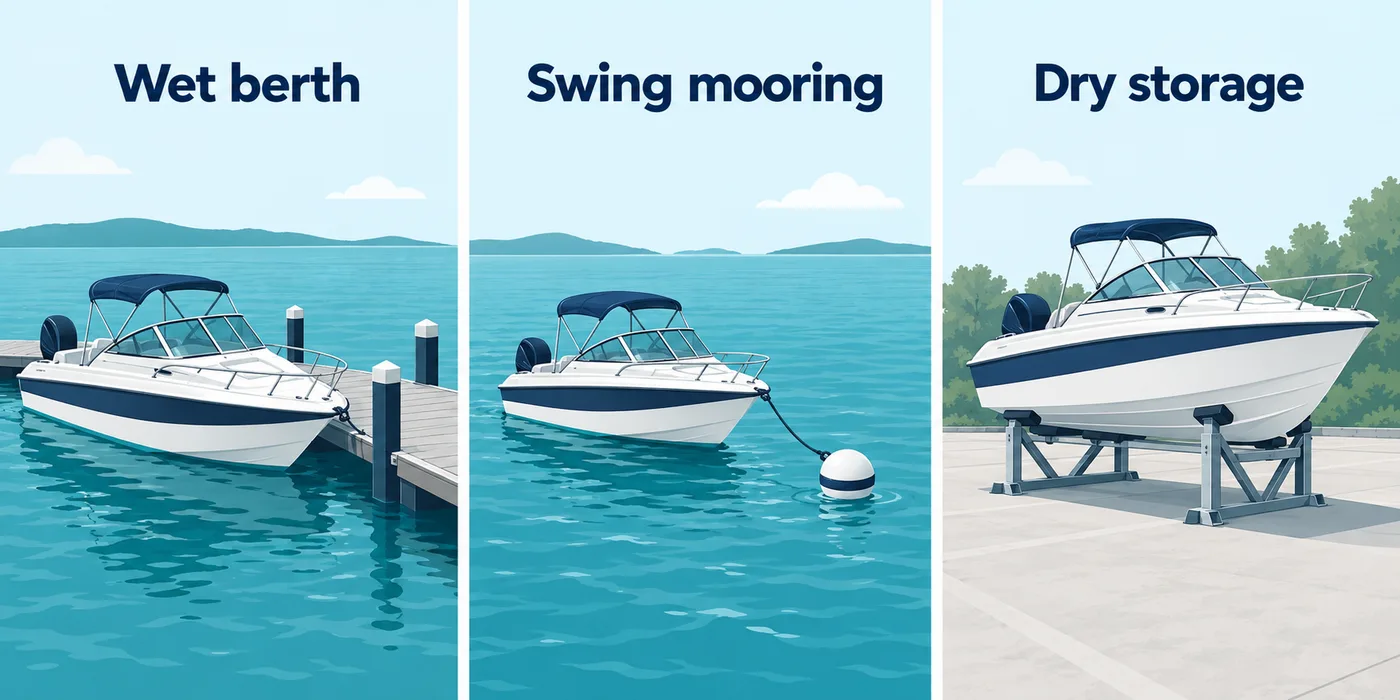
| Arrangement | Main practical question | Cost or access detail to verify |
|---|---|---|
| Wet berth | Can you reach and board your boat when needed? | Utilities, access and maintenance arrangements |
| Swing mooring | How do crew and supplies get aboard? | Tender or transfer arrangements and their availability |
| Dry storage | How are launches and retrievals requested? | Included movements, operating hours and vessel limits |
| Trailer storage | Who tows and launches the boat? | Trailer access, ramp use and vehicle parking |
A worked example
Illustrative scenario: an owner who plans Saturday outings several days ahead may find booked launches convenient. Another who decides to go out after work needs to understand the provider’s late-day process first. Test both products against a real week in your life rather than comparing only their monthly fees.
Wet berths, dry stack and hardstand storage
A wet berth may make a spontaneous departure easier, while dry-stack, hardstand or trailer storage can separate the boat from the water between trips. The best choice depends on your boat and how often you actually go out.
Do not treat every dry option as interchangeable. A dry stack has lift and launch procedures; hardstand may require a yard booking; trailer storage depends on ramp, vehicle and retrieval access.
- How often will I use the boat in a normal month?
- How much notice is needed to launch or retrieve?
- Can the boat be accessed after hours for maintenance or loading?
Boat size and launch-access requirements
Tell the operator length, beam, weight, height and hull type. Ask whether the lifting equipment, cradles, access roads and storage space suit that whole specification.
A wet berth has its own limits: pen dimensions, approach, utilities and exposure. Compare these to the dry option rather than assuming one mode is universally safer or cheaper.
- What maximum dimensions and weight apply to this storage method?
- Who handles lifting, lines and launch?
- How is the boat secured and accessed between trips?
Comparing storage costs and everyday convenience
Ask about wash-down, power for charging, fuel access, antifouling, trades, parking and the steps from arrival at the marina to being underway. Include the time needed at the end of a day on the water.
A useful shortlist compares two or three actual facilities for the same boat and use pattern. Request current quotes and procedures from each operator.
- What happens after I return later than planned?
- Is wash-down or charging included?
- Can the boat stay afloat temporarily for a multi-day trip?
QUESTIONS ANSWERED
Wet berth or dry storage?: questions answered
Is dry storage always cheaper than a wet berth?
Not necessarily. Compare current quotes, launch fees, included services and the time required for your normal use.
Does a marina’s dry-storage listing mean it has space?
No. The source record can note a storage option, but the operator must confirm current availability and vessel limits.
Can a sailing yacht use dry stack?
Only the operator can confirm the equipment and dimensions suitable for the specific yacht and rig. Many storage arrangements have physical limits.
Does dry storage include unlimited launches?
Do not assume it does. Ask about included movements, notice requirements, operating hours and any additional charges.
Is a swing mooring equivalent to a walk-on berth?
No. Reaching a moored boat generally requires a separate transfer arrangement. Confirm what is provided and what you must organise yourself.
For more common questions, visit the marina berth FAQ.